
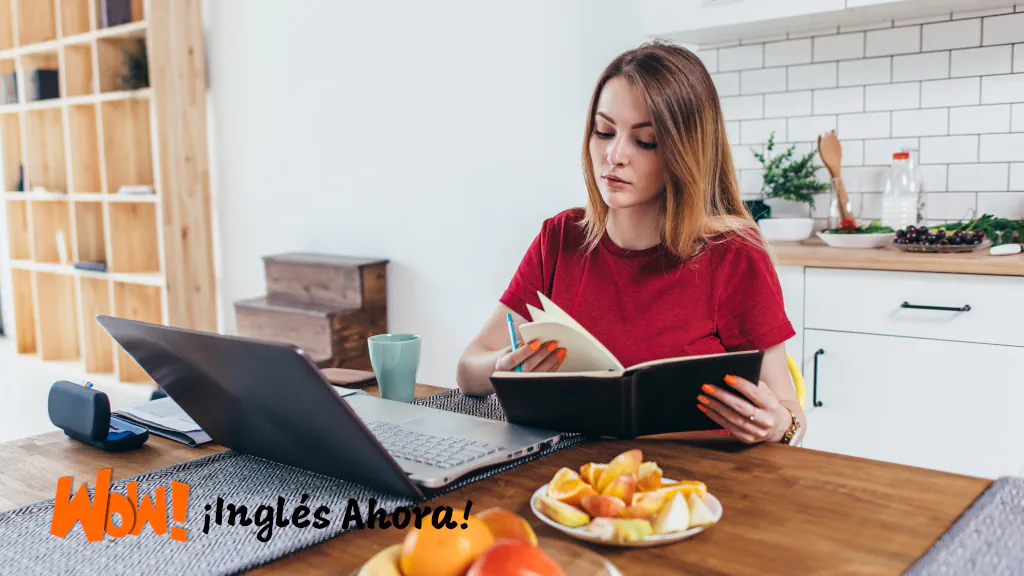
En este ejercicio vas a comparar dos tiempos verbales importantes: el Simple Present y el Present Continuous.
A Morning At Home —Una Mañana En Casa
Every morning, Elena studies English in her kitchen. She puts her notebook on the table and keeps her phone in her bag. Her bag is on the floor, next to the chair. She usually reads the words at the top of the page and writes new words at the bottom.
Right now, Elena is studying a short story. She is sitting at the table, and her phone is lying on the table next to her notebook. A pencil is in front of her book. She is reading one sentence and is writing its meaning in Spanish.
NOTA: Para practicar la historia con IPA y escuchar el audio, ve a la siguiente sección:
Ejercicio 1 – Observa Los Verbos En La Historia
Hay dos formas verbales importantes en esta historia:
- Simple Present /ˈsɪm.pəl ˈprɛz.ənt/: se usa para hablar de hábitos, rutinas o cosas que ocurren normalmente.
- Present Continuous /ˈprɛz.ənt kənˈtɪn.ju.əs/: se usa para hablar de una acción que está ocurriendo ahora.
Simple Present Verbs:
- studies /ˈstʌ.diz/ — estudia
- puts /pʊts/ — pone
- keeps /kips/ — mantiene / guarda
- reads /ridz/ — lee
- writes /raɪts/ — escribe
Present Continuous Verbs:
- is studying /ɪz ˈstʌ.di.ɪŋ/ — está estudiando
- is sitting /ɪz ˈsɪt̬.ɪŋ/ — está sentado / está sentada
- is lying /ɪz ˈlaɪ.ɪŋ/ — está acostado / está acostada
- is reading /ɪz ˈri.dɪŋ/ — está leyendo
- is writing /ɪz ˈraɪ.t̬ɪŋ/ — está escribiendo
Observa que el Present Continuous usa el verbo to be más un verbo que termina en -ing:
- I am studying.
- She is studying.
- They are studying.
Ejercicio 2 – Identifica El Tiempo Verbal
Las oraciones de la lista de abajo son oraciones de la historia que acabas de leer.
Lee cada oración y decide si el verbo en negrita está en:
- Simple Present
- Present Continuous
En tu cuaderno, escribe los números del 1 al 10. Al lado de cada número, escribe solamente: Simple Present o Present Continuous. No es necesario copiar las oraciones.
- Elena studies English in her kitchen every morning.
- She puts her notebook on the table.
- She keeps her phone in her bag.
- Her bag is on the floor.
- She usually reads the words at the top of the page.
- She is studying a short story right now.
- She is sitting at the table.
- Her phone is lying on the table.
- She is reading one sentence.
- She is writing its meaning in Spanish.
Respuestas
- Simple Present
- Simple Present
- Simple Present
- Simple Present
- Simple Present
- Present Continuous
- Present Continuous
- Present Continuous
- Present Continuous
- Present Continuous
Ejercicio 3 – Elige La Forma Correcta Del Verbo
Lee cada oración y elige la opción correcta. Escribe en tu cuaderno el número de la oración y la respuesta correcta.
- Elena (studies / is studying) English every morning.
- Right now, she (reads / is reading) a short story.
- She usually (puts / is putting) her notebook on the table.
- Today, her notebook (is / is being) on the table.
- Her phone (is / is lying) in her bag every morning.
- Right now, her phone (lies / is lying) next to her notebook.
- She (writes / is writing) new words at the bottom of the page every day.
- Now, she (writes / is writing) the meaning of one sentence in Spanish.
Respuestas:
- studies
- is reading
- puts
- is
- is
- is lying
- writes
- is writing
Ejercicio 4 – Completa Con La Forma Correcta Del Verbo
Completa cada oración con la forma correcta de los verbos entre paréntesis.
Busca las palabras que te indican la respuesta: every day, usually y every morning hablan de una rutina. Right now y now hablan de algo que está ocurriendo en este momento.
- Elena __________ English every morning.
(study) - Right now, she __________ at the table.
(sit) - She usually __________ her phone in her bag.
(keep) - Now, her phone __________ on the table.
(lie) - Every day, Elena __________ new words at the bottom of the page.
(write) - At this moment, she __________ the meaning of a sentence in Spanish.
(write)
Respuestas:
- studies
- is sitting
- keeps
- is lying
- writes
- is writing
Ejercicio 5 – Traduce Al Inglés
Traduce las siguientes oraciones al inglés. Usa Simple Present o Present Continuous, según sea necesario.
Escribe las oraciones completas en tu cuaderno.
- Elena estudia inglés todas las mañanas.
- Ella pone su cuaderno sobre la mesa.
- Su teléfono está en su bolsa.
- Ella escribe palabras nuevas en la parte de abajo de la página.
- Ahora Elena está estudiando una historia corta.
- Ella está sentada en la mesa.
- Su teléfono está sobre la mesa, junto a su cuaderno.
- Ella está leyendo una oración y está escribiendo su significado en español.
Respuestas:
- Elena studies English every morning.
- She puts her notebook on the table.
- Her phone is in her bag.
- She writes new words at the bottom of the page.
- Right now, Elena is studying a short story.
- She is sitting at the table.
- Her phone is on the table, next to her notebook.
- She is reading one sentence and is writing its meaning in Spanish.
Refuerzo: ¿Cuándo Usamos Simple Present y Present Continuous?
La idea más importante es esta:
- El Simple Present habla de lo que una persona hace normalmente, como una rutina o un hábito.
- El Present Continuous habla de lo que una persona está haciendo ahora, en este momento.
Compara estas dos oraciones:
- Elena studies English every morning.
- Elena estudia inglés todas las mañanas.
↑ Esta oración habla de su rutina. No dice que Elena está estudiando exactamente en este momento.
↓ Esta oración habla de una acción que está ocurriendo ahora.
- Elena is studying English right now.
- Elena está estudiando inglés ahora mismo.
Para formar el Present Continuous, usa esta formula:
- sujeto + am / is / are + verbo con -ing
Ejemplos:
- I am reading.
- You are reading.
- He / She is reading.
- We / They are reading.
Una pregunta que te puede ayudar: ¿La oración habla de una rutina o habla de algo que está pasando ahora?
- Si habla de una rutina, usa Simple Present.
- Si habla de ahora, usa Present Continuous.
Practica La Historia Con IPA
Lee cada oración en voz alta. Después, usa la transcripción IPA para practicar las palabras nuevas y verificar tu pronunciación.
Párrafo 1:
- Every morning, Elena studies English in her kitchen.
- /ˈɛv.ɚ.i ˈmɔr.nɪŋ, əˈleɪ.nə ˈstʌ.diz ˈɪŋ.ɡlɪʃ ɪn hɚ ˈkɪtʃ.ən/
- Todas las mañanas, Elena estudia inglés en su cocina.
- She puts her notebook on the table and keeps her phone in her bag.
- /ʃi pʊts hɚ ˈnoʊt.bʊk ɑn ðə ˈteɪ.bəl ænd kips hɚ foʊn ɪn hɚ bæɡ/
- Ella pone su cuaderno sobre la mesa y guarda su teléfono en su bolsa.
- Her bag is on the floor, next to the chair.
- /hɚ bæɡ ɪz ɑn ði flɔr, nɛkst tu ðə tʃɛr/
- Su bolsa está en el piso, junto a la silla.
- She usually reads the words at the top of the page and writes new words at the bottom.
- /ʃi ˈju.ʒu.ə.li ridz ðə wɝdz æt ði tɑp əv ðə peɪdʒ ænd raɪts nu wɝdz æt ði ˈbɑ.təm/
- Ella normalmente lee las palabras en la parte de arriba de la página y escribe palabras nuevas en la parte de abajo.
Párrafo 2:
- Right now, Elena is studying a short story.
- /raɪt naʊ, əˈleɪ.nə ɪz ˈstʌ.di.ɪŋ ə ʃɔrt ˈstɔr.i/
- Ahora mismo, Elena está estudiando una historia corta.
- She is sitting at the table, and her phone is lying on the table next to her notebook.
- /ʃi ɪz ˈsɪt.ɪŋ æt ðə ˈteɪ.bəl, ænd hɚ foʊn ɪz ˈlaɪ.ɪŋ ɑn ðə ˈteɪ.bəl nɛkst tu hɚ ˈnoʊt.bʊk/
- Ella está sentada en la mesa, y su teléfono está sobre la mesa, junto a su cuaderno.
- A pencil is in front of her book.
- /ə ˈpɛn.səl ɪz ɪn frʌnt əv hɚ bʊk/
- Un lápiz está enfrente de su libro.
- She is reading one sentence and is writing its meaning in Spanish.
- /ʃi ɪz ˈri.dɪŋ wʌn ˈsɛn.təns ænd ɪz ˈraɪ.tɪŋ ɪts ˈmi.nɪŋ ɪn ˈspæn.ɪʃ/
- Ella está leyendo una oración y está escribiendo su significado en español.